A concrete stair that does two jobs
One sloping wall of concrete carries the handrail, shapes the steps and divides the space. A close look at a simple stair.
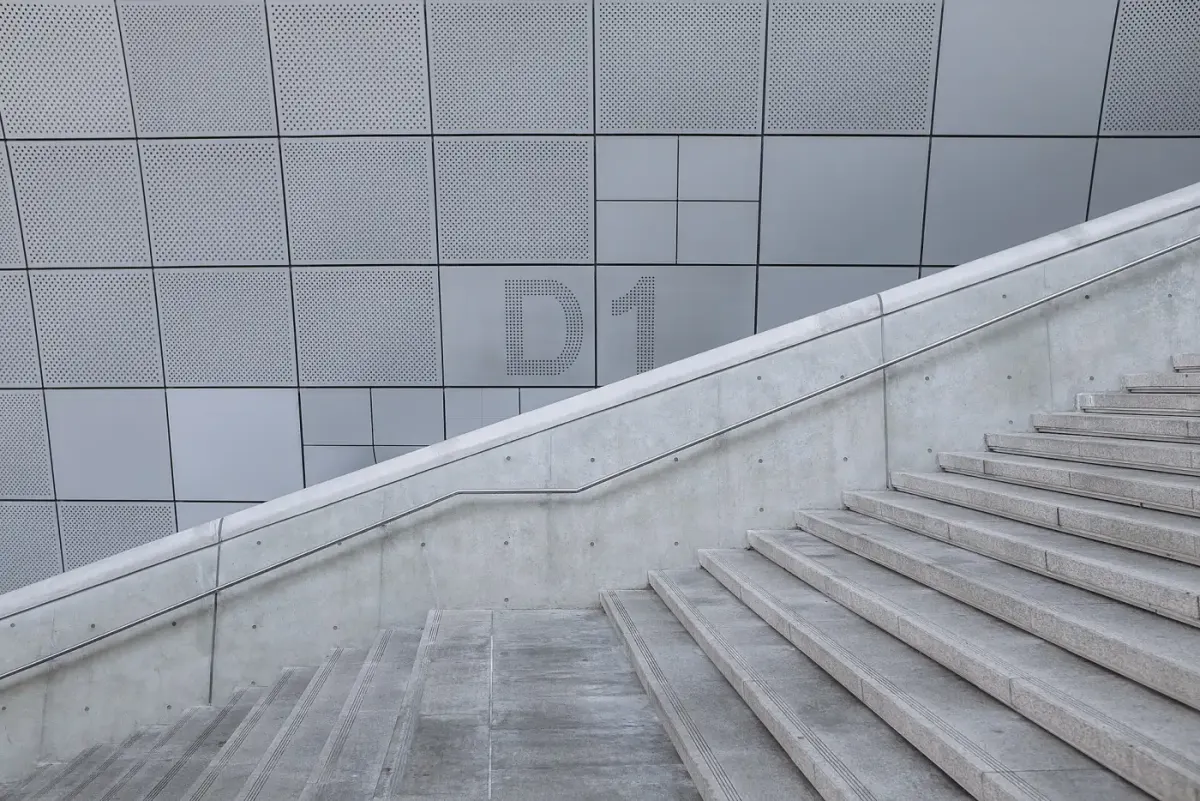
The best stairs are the ones you stop noticing. This one, with its long diagonal line cutting across a grid of metal panels, is hard to ignore, yet nothing in it is decorative. Every part is working.
The photograph shows a broad flight rising to the right, with a concrete balustrade wall along its edge. Behind it, a perforated metal facade is divided into rectangles of different sizes. The contrast between the two is the whole composition.
A wall that is also a rail
The parapet wall is where the stair earns its second job. It protects the edge, so nobody needs a fragile railing there. It also carries a slim steel handrail on its face, set at a comfortable height, and it gives the flight a clean edge that you can read from far away.
The concrete itself is plain, cast with neat circular marks left by the formwork ties. It is a good material for a stair that will be used by thousands of people, because it is hard, easy to wash and gets better with a little weathering.
Making steps comfortable
The steps are wide and shallow, with a fine groove near each edge so a shoe does not slip. They are also long enough to function as seating, which is why stairs like this tend to be full of people sitting down between floors. The stair, in other words, is also a small public room.