Along the waterfront in Oslo
Grey-clad housing, stepped quays and a floating pier turn a harbour edge into a place people actually sit and swim.
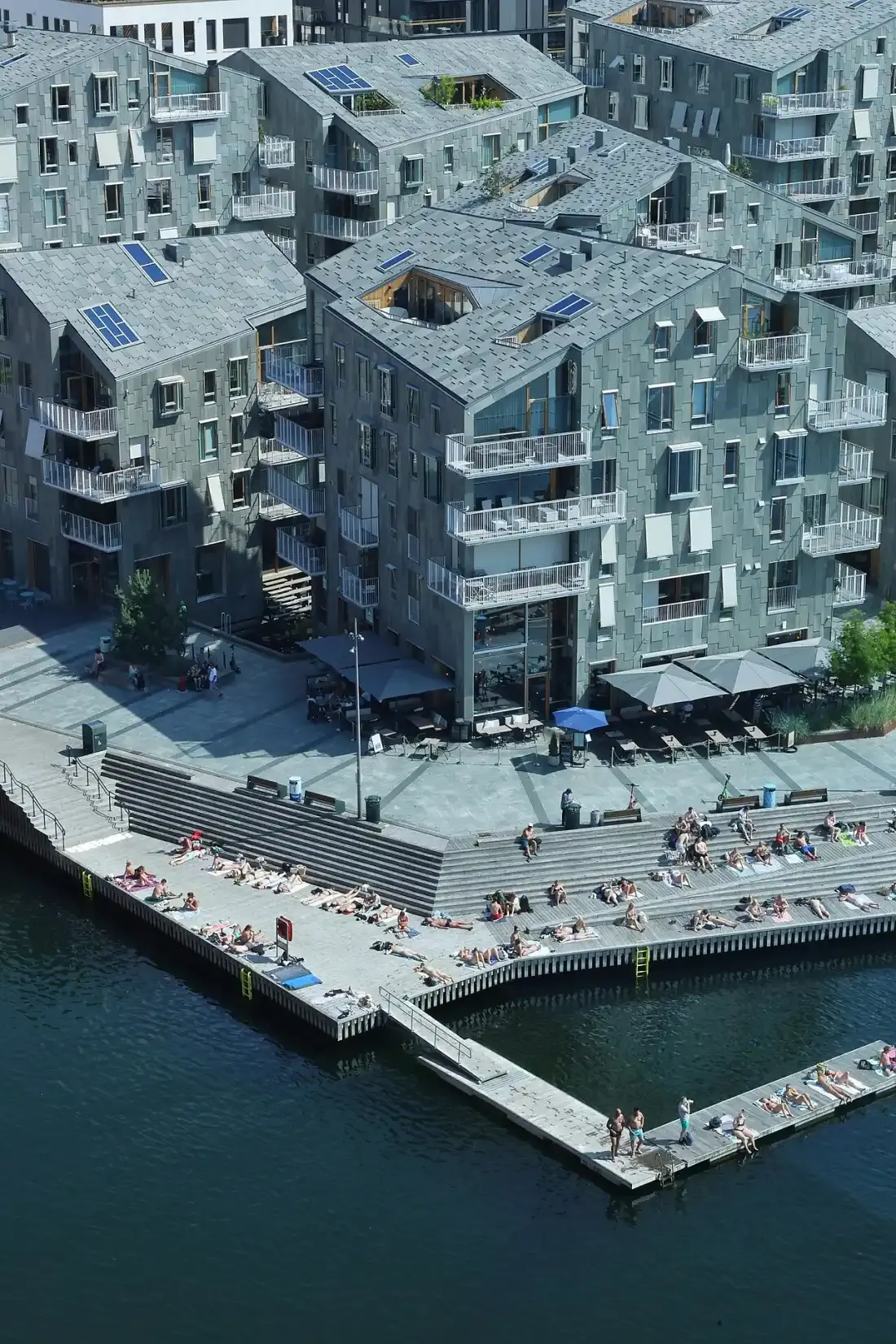
On a warm day, the edge of a city can tell you whether it was designed for people. In this photograph of a recent Oslo waterfront district the answer is plain. Dozens of strangers are lying on stepped timber and stone, a few paces from the water, under a cluster of tall housing blocks. Nobody has fenced them in and nobody is selling them anything.
It is worth asking how a place like this gets built, because the harbour edge is usually the most contested land in a city, and the easiest to get wrong.
Steps instead of a railing
The most important feature is also the simplest. Instead of a vertical quay wall with a rail on top, the edge descends in broad steps. They work as seating, as a sunbathing deck and as a way to get close to the water, all in one. People of every age can find a place at a height they like.
Further out, a narrow floating jetty reaches into the harbour. It gives swimmers a way in, with ladders at intervals, and it changes the water from a view into something you can use.
Housing with a roofline
Behind the quay, the buildings step up in a series of pitched roofs clad in the same grey stone-like material, laid in irregular rectangles. The result is a district that feels like a small town rather than a single block. Individual blocks have their own gables, and the gaps between them let in light and views.
Balconies and terraces face the water, and the ground floors are open to cafe tables with parasols. This is the second quiet decision: the base of each building is given to the public, not to a car entrance or a blank wall.
What a district like this gets right
If you were writing a short checklist for a waterfront, the photograph supplies most of it:
- Public access along the whole edge, not only at one viewpoint.
- Seating that is built into the ground, so there is plenty of it.
- Cafes and homes facing the water, which keeps the place occupied from morning until late.
- A material palette limited to stone, timber and slate-coloured cladding.
- A route down to the water for people who want to swim.
Limits and trade-offs
It would be naive to call this a perfect model. A waterfront like this is expensive land, and the housing above it is unlikely to be cheap. The materials are handsome but hard, and on a cold grey day the broad stone terraces will feel empty. A district earns its reputation across a full year, not on one sunny afternoon.
Even so, the basic idea carries well beyond Oslo. Treat the water's edge as a shared room, make it easy to sit down, and let people from the nearby buildings use it without being asked to.
The test of a waterfront is simple: do people lie down on it?
In this photograph they do, in large numbers, and that says more than any plan drawing could.