Brick, hedges and a street that holds together
Rows of brick terraces behind low hedges give a London street its calm. A closer look at how repeated parts make order.
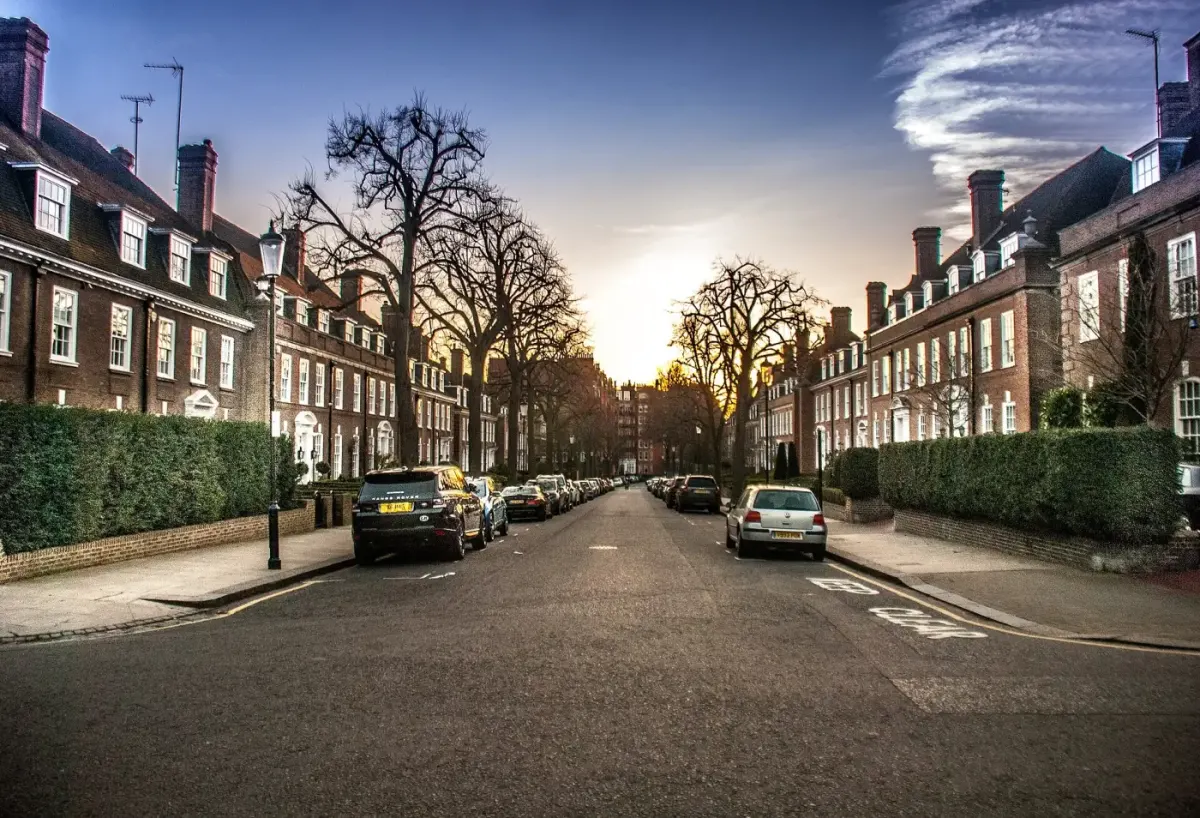
The street in the photograph is quiet, and not because it is empty. It has parked cars, lamp posts, bare trees and dozens of windows. What it has, above all, is agreement. Almost everything you can see is brick, white-framed windows or clipped green hedge, and it all sits at much the same height.
That agreement is the main thing a good residential street offers. It lets a person walk home and feel that every house belongs to the same place.
The hedge and the low wall
Between pavement and house, there is a small band: a low brick wall, a hedge, a path. It is a simple buffer. Residents get a little privacy, the street gets a green edge, and passers-by get a softer view than they would from a bare brick wall at the kerb.
The dormer windows in the roofs make a second rhythm above, a row of small gables repeated down the street.
Trees and light
The winter trees in the middle of the road frame a narrow slice of sky at the end of the street. At dusk, that is the brightest thing in the picture, and it draws the eye along the street. A long straight line of houses can feel monotonous, but with a bend or a glow at the end it becomes a view. It is a small reminder that streets are also rooms with a ceiling, and the ceiling is the sky.